


Two restaurants asked us the same question in the same week. One had been open eleven years in Mississauga. The other opened in a converted garage in Hamilton nine days earlier. Both wanted to know whether to start with Google or Meta.
They got opposite answers, and both were right.
This is the part most comparison articles skip. The honest answer is not "Google" or "Meta", it is "depends whether people are already searching for what you sell". For an eleven-year-old Mississauga restaurant, hundreds of people type the cuisine plus the neighbourhood every month. For a nine-day-old garage kitchen, nobody is searching for it, because nobody knows it exists.
Below: what each channel actually does, which one to start with in your situation, and how to split the money once both are running. If you are still working out the number itself, start with how much a restaurant should spend on Google Ads.
What is the real difference between Google Ads and Meta Ads?
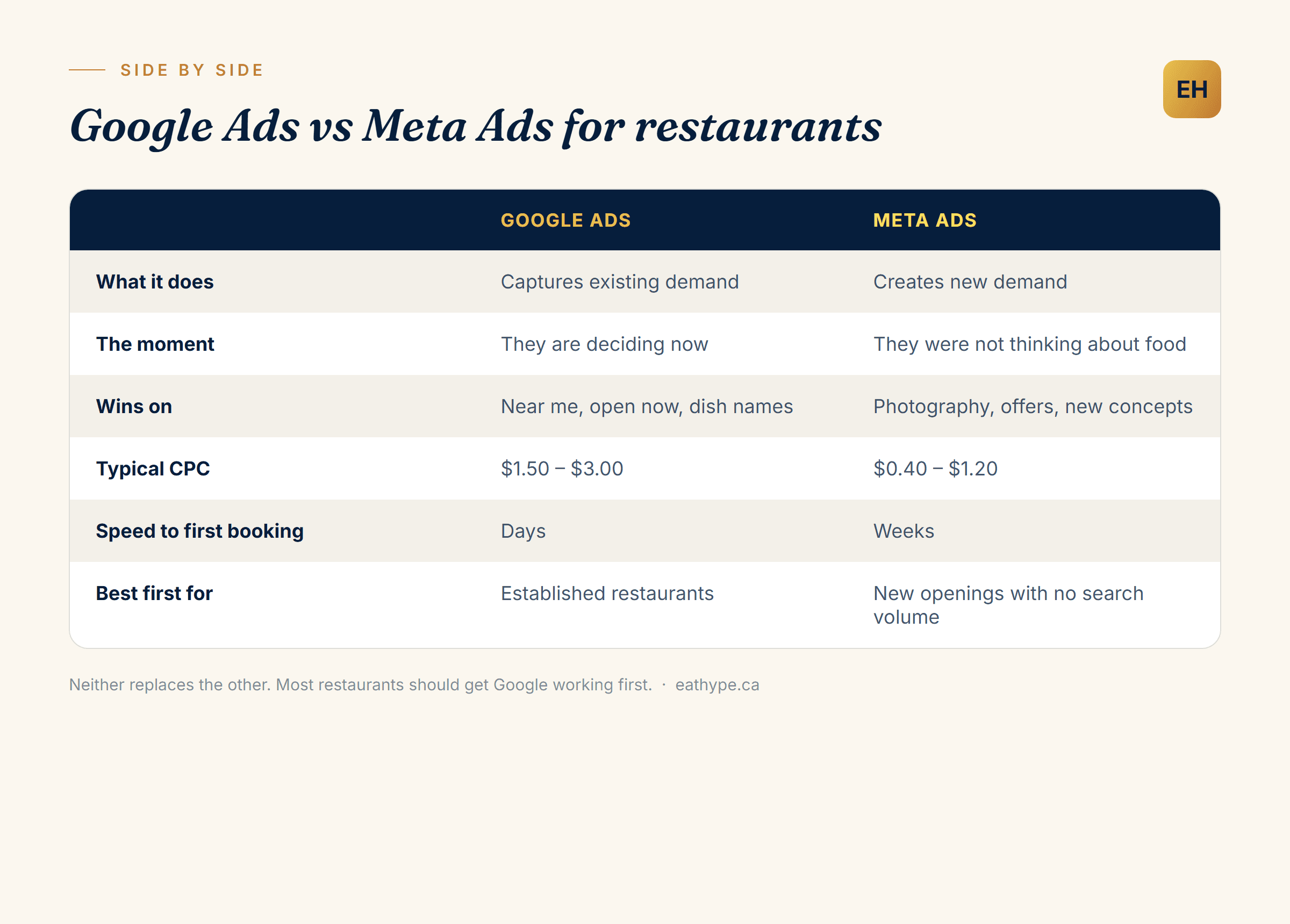
Google captures demand that already exists: someone is searching for food right now. Meta creates demand that did not exist: someone scrolling gets shown your food and decides they want it. Capture versus creation, not better versus worse.
Everything else follows from that one distinction. The targeting, the creative, the cost, how fast it works, and how you measure it all differ because the underlying job differs.
Google reaches people at the decision point
Somebody types "butter chicken near me open now" at 7:40pm. They are not researching. They are deciding, and twenty minutes later they are eating somewhere. That is the highest-intent moment in the entire restaurant funnel, and paid search is how you sit above the organic results at exactly that second.
The limit is volume. Google can only show you to people who search, so if nobody searches for your cuisine in your area, no budget creates that demand. You are fishing in a pond of fixed size.
Meta reaches people before they have decided anything
Nobody opens Instagram hungry for your restaurant specifically. They open it bored. A short clip of cheese pulling off a slice at the right moment changes that, and food is one of the few categories where the product genuinely sells itself on camera.
The limit is patience. You are interrupting somebody who was not looking for you, so a larger share of the audience ignores you, and the ones who do not often act days later. Meta clicks are cheaper, typically $0.40 to $1.20 against Google's $1.50 to $3.00, but a Meta click is worth less because the intent behind it is weaker.
- $1.50–$3.00
- typical restaurant cost per click, Google
- $0.40–$1.20
- typical restaurant cost per click, Meta
- Days vs weeks
- time to first attributable booking
Which should a restaurant start with?
Start with Google if people already search for your cuisine in your area, which covers most established restaurants. Start with Meta if you are brand new, visually distinctive, or selling something nobody thinks to search for yet.
Run this test before spending anything. Open Google, type your cuisine plus your neighbourhood, and look at whether ads appear. If competitors are paying to be there, demand exists and somebody is already capturing it. That is the cheapest market research available and it takes forty seconds.
Start with Google if
- You have been open long enough that people search your name, your cuisine, or your dishes.
- You depend on calls, bookings or direct online orders rather than walk-by traffic.
- Delivery aggregators are bidding on your brand name and taking commission on orders that should be yours.
- You do catering, events or corporate lunches, where a single enquiry is worth ten covers and buyers search deliberately.
- You need results this month rather than this quarter.
Start with Meta if
- You opened in the last few months and search volume for your name is effectively zero, which is where a proper restaurant launch plan earns its keep.
- Your concept is visual enough that a photo does the selling: dessert bars, brunch, anything with a signature dish people photograph.
- You are a destination rather than a convenience, so people travel to you deliberately instead of searching "near me".
- You run events, DJ nights or seasonal menus that nobody would think to search for.
- Your budget is under $500 a month, where Google cannot gather enough conversion data to optimise.
Most established restaurants land in the first list. That is why our default recommendation is Google Ads first, then Meta Ads second, and why we say so even though Meta is the easier sell in a first meeting because the creative looks impressive.
How do you split budget once both are running?
Roughly 70% Google and 30% Meta for established restaurants, flipping to 40/60 for new openings. Keep them in separate campaigns with separate reporting so one cannot quietly absorb the other's budget.
Do not add the second channel until the first is profitable. Splitting a budget that is not yet working just gives you two accounts that are not working, and twice as many places to look for the problem.
| Situation | Meta | Why | |
|---|---|---|---|
| Established, search demand exists | 70% | 30% | Capture first, top up with reach |
| New opening, no search volume | 40% | 60% | Nothing to capture yet, so create it |
| Destination or event-led concept | 45% | 55% | People travel deliberately, visuals do the work |
| Catering and B2B focus | 80% | 20% | Buyers search deliberately, high value per enquiry |
| Under $500 a month total | 0% | 100% | Too little data for Google to optimise on |
Starting points, not rules. Shift toward whichever channel produces cheaper covers once you have eight weeks of data.
Beware the attribution trap
Meta counts a conversion when somebody merely saw an ad and later converted. Google counts a click. Put both dashboards side by side and the totals will exceed your actual bookings, sometimes badly, because both platforms claim the same guest.
The fix is to stop trusting either platform's self-reported number as truth. Count covers, calls and orders in one place you control, then use platform data only for relative direction. That is exactly what tracking setup and honest performance dashboards are for, and it is the single most common thing missing in accounts we inherit.
I did not want more likes. I wanted more orders. They focused on 'near me' searches, wrote better ads, and built a page that made people act. We now get calls during service hours, not random clicks.
What creative does each channel need?
Google needs specifics in text: dish, price, neighbourhood, offer. Meta needs motion and appetite: short vertical video of food being made or pulled apart, with the offer on screen in the first two seconds.
Reusing the same asset across both is the fastest way to waste money on either. They are different jobs.
Google: name the thing
"Award-winning contemporary dining" tells a hungry person nothing and competes with every other restaurant writing the same sentence. "Wood-fired margherita, $16, Queen West, tables tonight" tells them everything they need. Specifics beat adjectives, every time.
Meta: show the thing
Vertical video, under fifteen seconds, food in motion within the first two. Cheese pulling, sauce pouring, a knife going through something. Static plated photos underperform badly now. Shot on a phone in your own kitchen usually beats polished studio work, because it looks like the feed rather than an interruption of it.
Both channels then need somewhere decent to land. Sending either to a homepage with a video header and a cookie banner wastes the click, which is why a dedicated landing page is normally the highest-leverage fix available, and why conversion rate optimisation often returns more than raising the budget.
When should you add the second channel?
When the first is profitable at your target cost per booking for three consecutive weeks and its impression share is above roughly 80%. At that point extra budget buys weaker traffic, and the other channel is the better home for it.
There is a ceiling on demand capture. Once you are winning most of the auction for the searches that exist, more money buys looser matches and cost per booking climbs. That is the signal to open the second channel, not a calendar date.
- 01Confirm the first channel has hit target cost per booking for three straight weeks, not one good week.
- 02Check impression share. Below 60% there is still headroom where you are; above 80% you are near the ceiling.
- 03Open the second channel with 20 to 30% of total budget, taken from new money if possible rather than starving what already works.
- 04Give it eight weeks. Meta in particular needs longer than Google to produce attributable bookings.
- 05Compare cost per cover across both, not cost per click, then move budget toward whichever is cheaper.
One caution on step five: the channels help each other in ways the reports will not show you. Meta builds recognition, so more people later search your name, and those Google conversions look cheap because the brand terms are cheap. Cut Meta entirely and Google's numbers often drift worse a month later for no visible reason. Watch total covers against total spend, not just the per-channel columns.
If you are running both across several sites, keep budgets and reporting separate per location. Shared pots hide which city is carrying which, and that is where social media strategy and paid media need to line up rather than run independently.
Google Ads vs Meta Ads: common questions
Is Meta cheaper than Google Ads for restaurants?
Per click, yes: roughly $0.40 to $1.20 against $1.50 to $3.00. Per booking it is usually closer, because Google clicks come from people already deciding where to eat.
Can a restaurant run both on a small budget?
Under about $1,000 a month total, pick one and do it properly. Splitting a small budget leaves neither channel with enough conversion data to optimise, so both underperform.
Which channel is better for a brand new restaurant?
Meta, usually. Nobody searches for a restaurant they have never heard of, so there is no demand to capture yet. Add Google once your name and cuisine start getting searched.
Do Instagram ads count as Meta Ads?
Yes. Instagram and Facebook are bought through the same Meta Ads platform, and most restaurant campaigns should run across both placements rather than choosing one.
Why do Google and Meta both claim the same booking?
Meta counts view-through conversions, Google counts clicks, and neither knows about the other. Track bookings in one place you control and treat platform numbers as direction rather than truth.
Should catering campaigns use Google or Meta?
Google, heavily. Corporate catering buyers search deliberately with clear intent, and a single enquiry can be worth ten covers, which justifies a much higher cost per lead.