


An owner in Etobicoke asked us this in February with a number already in his head: $200 a month. He had picked it because it felt safe. Three months later he had spent $600, learned nothing, and concluded Google Ads does not work for restaurants.
He was half right. $200 a month does not work. It is not enough to gather the data the system needs to get better, so you pay for the learning period over and over and never reach the part where it pays back.
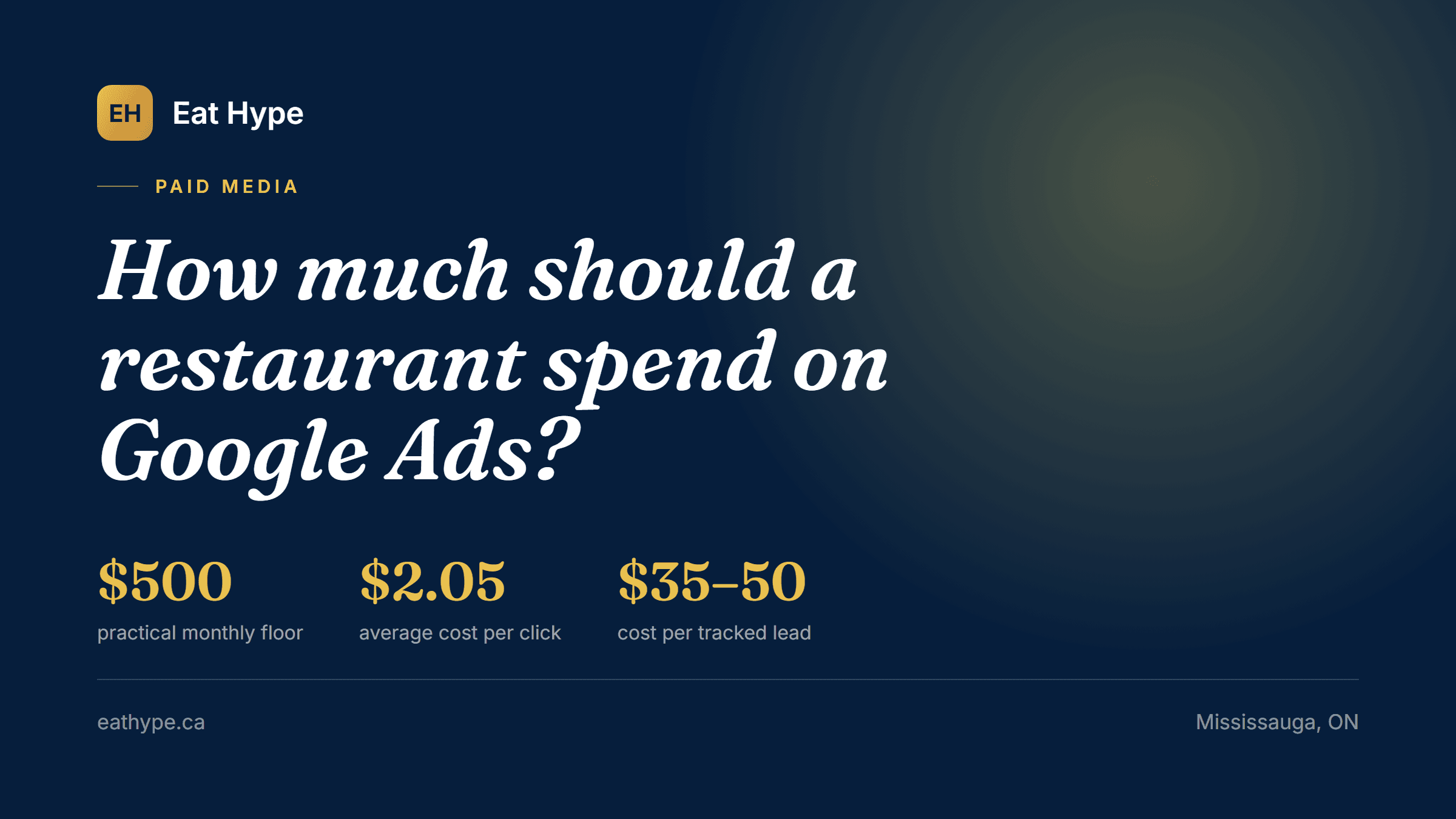
Restaurants sit in one of the cheapest categories in Google Ads. Average cost per click across restaurants and food runs about $2.05 against $8.58 for law firms, going by published 2026 benchmark data. That is the good news. The bad news is that a restaurant cover is worth a fraction of a legal case, so the maths is tighter than the low click price suggests.
Below are the numbers we actually work with when we run Google Ads for restaurants, what each budget tier buys in a Canadian market, and the point where adding money stops helping.
How much should a restaurant spend on Google Ads each month?
Most single-location restaurants need $500 to $1,500 a month in media spend. Competitive downtown markets need $1,200 to $2,500. Below roughly $500 there is not enough conversion data to optimise, so the account never improves.
The floor matters more than the ceiling. Google's bidding needs conversions to learn from, and a restaurant campaign generating four or five tracked actions a month gives it almost nothing to work with. Around 15 to 30 conversions a month is where accounts start behaving predictably, and at a $35 to $50 cost per lead that puts the floor near $500.
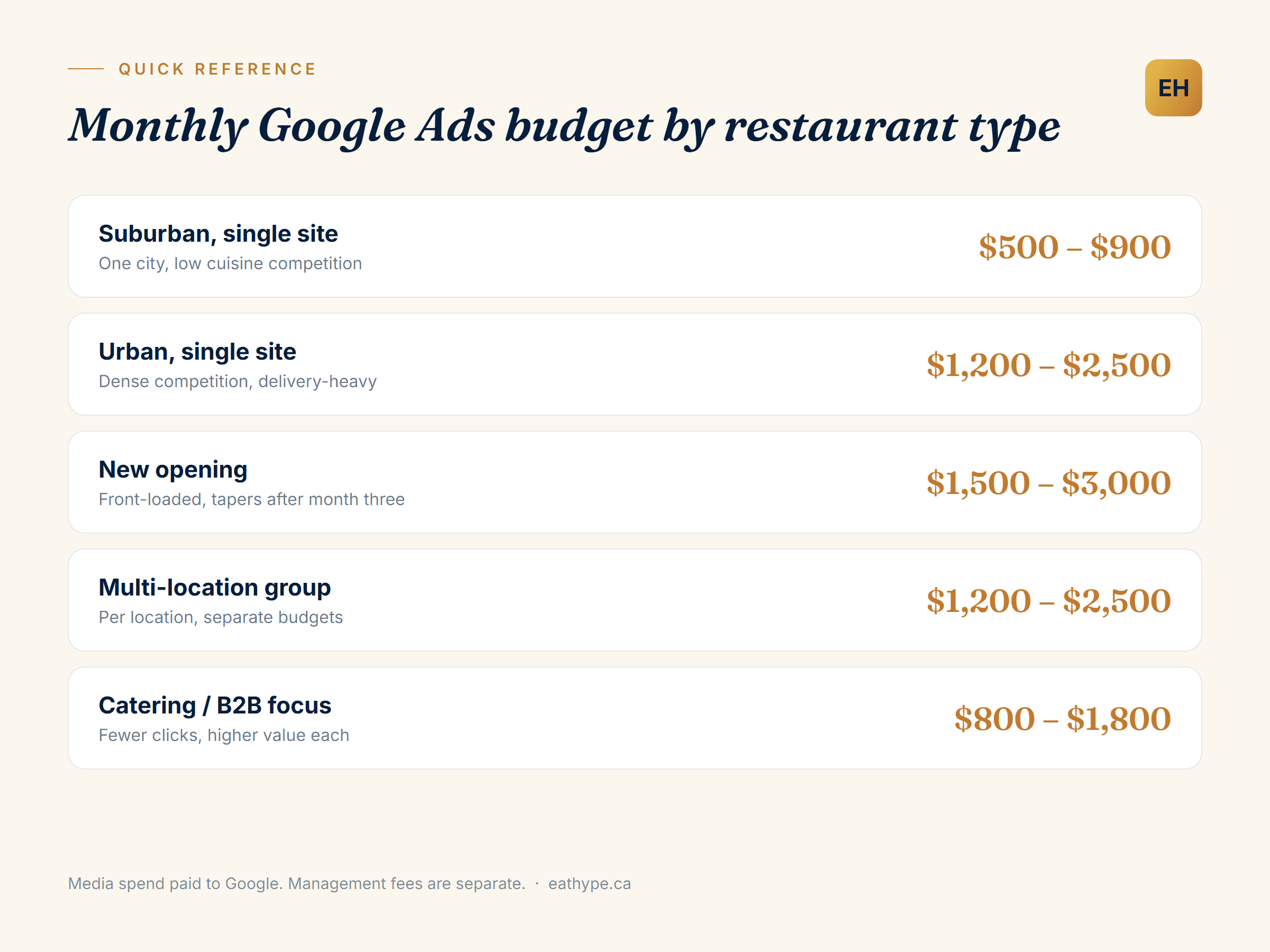
Two things move you up a tier faster than anything else: how many restaurants of your cuisine sit within a ten-minute drive, and whether you are fighting delivery aggregators for your own brand name. A Thai place in a small Ontario town and a Thai place on Queen West are not in the same auction, even though the click price looks similar on paper. If you are running several sites, multi-location campaigns need separate budgets and reporting per city rather than one shared pot.
Why $200 a month genuinely cannot work
At roughly $2 a click, $200 buys about 100 clicks. Spread across a month, that is three clicks a day. If 5% of them convert, you get five actions in thirty days. Google cannot optimise on five data points, you cannot tell a good week from a bad one, and one quiet Tuesday looks like a catastrophe.
If $500 a month is not available right now, that is a completely reasonable position. Put the money into your Google Business Profile and local SEO instead, where the payback is slower but the floor is much lower. We would rather say that than take a retainer to run an account that cannot succeed.
What does $500, $1,000 or $2,500 a month actually buy?
Roughly 165 to 330 clicks at $500, 330 to 660 at $1,000, and 830 to 1,650 at $2,500 based on typical restaurant click costs. Expect 10 to 20 tracked leads per $500 spent once tracking is set up properly.
Clicks are the easy part to predict. What they turn into depends almost entirely on where you send them and whether you count properly.
| Monthly spend | Clicks | Tracked leads | What that looks like |
|---|---|---|---|
| $500 | 165 – 330 | 10 – 20 | A steady trickle of calls, mostly weekends |
| $1,000 | 330 – 660 | 20 – 40 | Daily call volume, enough data to optimise monthly |
| $1,500 | 500 – 1,000 | 30 – 60 | Calls plus directions requests, weak nights start filling |
| $2,500 | 830 – 1,650 | 50 – 100 | Meaningful share of voice in a competitive core |
Assumes $1.50–$3.00 per click and a $35–$50 cost per lead. A lead is a call, booking or order click, not a cover.
Note the gap between leads and covers. A tracked lead is somebody who called, started a booking, or clicked to order. Most of them convert, but not all, and a phone that rings during service and nobody answers is a lead you paid for and lost. A tidy POS and ordering setup closes more of that gap than extra budget ever will. That is an operations problem, not an ads problem, and no budget fixes it.
- $2.05
- average cost per click, restaurants and food
- $8.58
- average cost per click, legal services
- $35–$50
- typical cost per tracked restaurant lead
How should you split a restaurant's Google Ads budget?
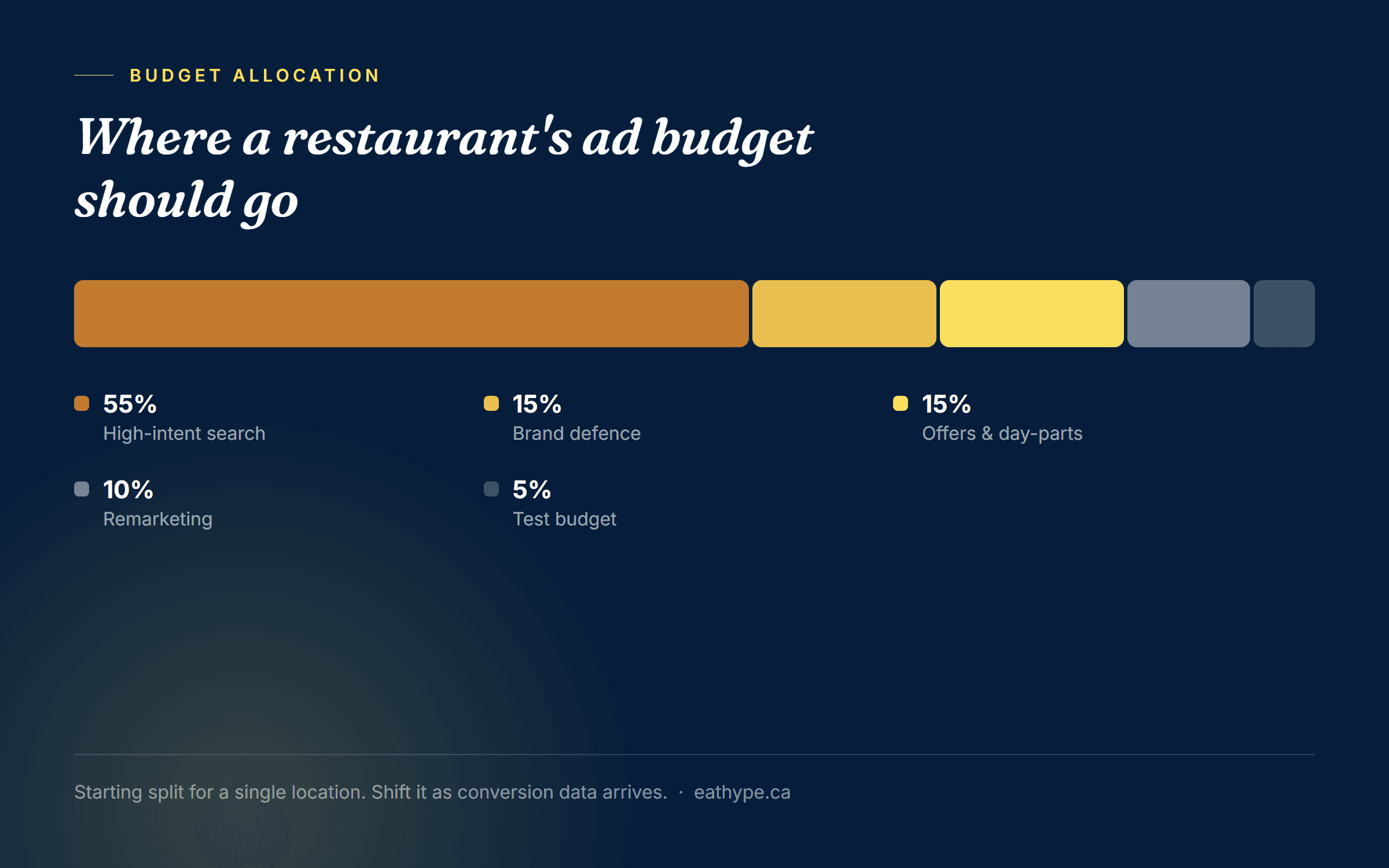
Put the majority into high-intent search on dish and near-me terms, hold a slice for brand defence, and keep a small test budget. Do not touch broader formats until search is producing profitable covers.
A single campaign spending the whole budget on everything is the most common structure we inherit, and it hides which part is working. Splitting it costs nothing and makes the account readable.
Brand defence is the cheapest money in the account
Type your own restaurant name into Google. If a delivery platform is bidding on it, every order that comes through that click costs you commission you would not otherwise pay. Your own brand terms have a high quality score, so those clicks are unusually cheap, and it is normally the fastest saving we find in a first month.
Weight spend toward the run-up to service
People search before they leave the house, not while they are sitting down. Flat all-day bidding spends your budget on 2pm browsers and leaves you dry at 6pm. If dinner drives 60% of your revenue, it should not be receiving 25% of your ad spend.
What is a good cost per booking for a restaurant?
Between $35 and $50 per tracked lead is normal, which usually lands at $45 to $70 per confirmed cover. Judge it against your average cover value and repeat rate, never against another industry's numbers.
The number only means something next to your own economics. A $32 average cover at 30% food cost leaves roughly $22 of contribution. Paying $50 to acquire that guest looks like a loss, and it is, on the first visit.
It stops being a loss the moment they come back. If a third of first-time guests return twice more in a year, that $50 buys roughly $66 of contribution, not $22. Restaurants that judge ads on first-visit ROI almost always underspend, because they are measuring a third of the value they actually receive.
This is also why catering and events change the maths entirely. One corporate catering enquiry can be worth thirty covers, so a $200 cost per lead there is cheap. Splitting catering into its own campaign, rather than letting it compete with $14 lunch clicks, is usually worth more than any bid adjustment, and it pairs naturally with dedicated lead generation work.
When should you increase or cut your Google Ads spend?
Increase when a campaign is limited by budget and still profitable at your target cost per booking. Cut when impression share is already high and extra spend only buys weaker traffic. Never scale an account with broken tracking.
Google will tell you a campaign is limited by budget. That message alone is not a reason to spend more. It is only a reason if the campaign is hitting your cost per booking target while it is limited.
- 01Check that conversions are tracked properly, including phone calls. Scaling an account you cannot measure just increases the size of the mistake.
- 02Confirm the cost per booking is at or under target for at least three consecutive weeks, not one good week.
- 03Look at search impression share. Below about 60% there is genuine headroom. Above 85% you are already winning most of the auction and extra budget buys looser matches.
- 04Raise the budget by 20 to 30%, not double. Large jumps reset the learning period and results wobble for a fortnight.
- 05Hold for two weeks and compare cost per booking, not click volume.
Cutting follows the same logic in reverse. If cost per booking has climbed for three straight weeks and impression share is already high, the auction is telling you the ceiling is near. Trim back to the spend level that was profitable and put the difference into conversion rate optimisation or website A/B testing, where the gains are not capped by an auction.
We were burning money on Google ads and could not tell what worked. EatHype cleaned the setup, blocked junk searches, and fixed tracking. Within weeks, calls and bookings became steady.
What should you fix before spending more on ads?
Conversion tracking, your Google Business Profile, and the page the ads point at. Each of these changes the return on every dollar you spend afterwards, and all three are cheaper than a budget increase.
Raising the budget multiplies whatever is already happening. If the funnel leaks, you are buying more leaks.
Tracking, before anything else
Restaurants convert on the phone more than almost any other local business, and phone conversions are the ones most often missing from the account. Without them, automated bidding optimises toward whatever produces cheap web clicks and quietly moves budget away from what actually rings the phone. Google documents how call conversion tracking works if you want the mechanics, but getting tracking setup right usually changes the numbers more than any bid change, and it feeds every performance dashboard you build afterwards.
Your Google Business Profile
Ads and Maps feed each other. A thin profile with old hours and four photos undercuts every click you buy, because people check it before they call. Google's own guidance on managing your Business Profile covers the basics. It costs nothing to fix and it lifts the restaurant SEO side at the same time.
Where the clicks land
Someone clicked an ad about your lunch special. A homepage with a video header and a cookie banner asks them to go find it, and on a phone, in the ninety seconds they have before deciding, they will not. A dedicated landing page with one offer, one action and a fast mobile load is the cheapest meaningful improvement available to most restaurants.
Get those three right and the same $1,000 does noticeably more. That is the honest answer to the budget question: how much you spend matters less than what the spend lands on.
Restaurant Google Ads budgets: common questions
What is the minimum Google Ads budget for a restaurant?
Around $500 a month in media spend. Below that there are too few conversions for the campaign to optimise, so the account never improves and the money teaches you nothing.
How much do restaurants pay per click on Google Ads?
Typically $1.50 to $3.00, averaging about $2.05 across restaurants and food. It is one of the cheapest categories in Google Ads, well under legal or dental advertising.
Is Google Ads worth it for a small independent restaurant?
Yes, if the budget clears roughly $500 a month and the targeting radius is tight. Below that, local SEO and your Google Business Profile give a better return on the same money.
How long before a restaurant Google Ads budget pays back?
Calls usually start in the first two weeks. Month three is the first month worth judging, because months one and two are spent gathering conversion data and cutting wasted spend.
Should management fees come out of the ad budget?
No. Media spend goes to Google, management is billed separately. Be wary of a straight percentage-of-spend fee with no floor, since it rewards spending more rather than spending better.
How much should a new restaurant spend before opening?
Between $1,500 and $3,000 a month, front-loaded across the launch window as part of a wider [restaurant launch plan](/restaurant-launch-plan/), then tapered from month three as organic visibility and reviews start carrying more of the demand.